Case Study: A QCD in Real Life

If you are an estate planning attorney, CPA, or financial advisor, you likely know the basics of Qualified Charitable Distributions (QCDs). Still, you may have a hard time envisioning exactly what to say and do when they come up in a client conversation, you are not alone! Whether you are an attorney, CPA, or financial advisor, at some point you will find yourself in the middle of a QCD conversation. Here’s a case study to help you be prepared. 

Margaret, a 74-year-old widow and longtime client of your practice, scheduled a meeting early in the year to discuss her charitable giving plans. In the email Margaret sent to set up the meeting, she mentioned that she was now taking required minimum distributions from her IRA and her taxable income was higher than she expected or needed. 

As you reviewed Margaret’s file prior to the meeting, you were reminded that Margaret had established a donor-advised fund at the community foundation several years ago. You recall from prior conversations that Margaret not only has enjoyed using the donor-advised fund to organize her charitable giving to dozens of favorite charities, but she’s also appreciated the many opportunities to tap into the community foundation’s events and educational opportunities. 

Margaret arrived at your office, and after catching up on each other’s lives lately, Margaret said, “I’ve read about this thing called a Qualified Charitable Distribution. If I’m going to give to charity anyway, I want to understand whether doing a QCD in 2026 makes sense, especially if I want the gift to go through the community foundation where I already do all of my giving.”

You nod and explain that a QCD does indeed allow individuals like her who are age 70 ½ or older to transfer funds directly from an IRA to a qualified charity without including that amount in taxable income. You mention that this can be especially powerful after age 73, when required minimum distributions begin, because the QCD can satisfy all or part of the RMD while keeping adjusted gross income lower. “This can help address Medicare premiums, taxation of Social Security, and overall tax efficiency,” you continue. “With the annual QCD limit increasing through inflation adjustments to $111,000 in 2026, it’s a timely strategy to consider.”

Margaret was glad to hear all of this. Then she asked, “I already have a donor-advised fund at the community foundation. Can I simply direct my QCD straight into that fund?” You are prepared for this question! It is a common point of confusion. “That’s a great question, and you’re not alone in asking it,” you reply. “Under current IRS rules, unfortunately, QCDs can’t be made to donor-advised funds, even if they’re housed at a community foundation.”

Seeing her puzzled expression, you continue with a broader explanation. “QCDs are limited to certain types of charitable recipients,” you say. “They can go directly to public charities that are ‘operating’ nonprofits, and in limited cases to certain split-interest arrangements like a charitable gift annuity or a charitable remainder trust, subject to specific rules. Donor-advised funds are excluded, evidently because the IRS does not want the money to flow into account where the taxpayer retains advisory privileges. Donor-advised funds are of course entirely dedicated to charity, so the rule does not make a lot of sense. Yet here we are.”

Margaret frowned slightly. “That feels frustrating,” she said. “I love the donor-advised fund because it gives me flexibility and lets me support multiple causes over time.” You acknowledged her concern. “I understand. The good news, though,” you say, “is that the community foundation offers other types of funds that do qualify for QCDs and can still accomplish many of the same goals.”

You go on to explain that instead of directing the QCD to her donor-advised fund, Margaret could direct the QCD to a designated fund at the community foundation that supports specific charities she already knows she wants to help, or to a field-of-interest fund focused on causes she cares about deeply, such as education or the arts, or to an unrestricted fund to support the community as a whole. “Those types of funds are fully managed by the community foundation, without your advisory role after setup,” you say, “which makes them eligible recipients of a QCD while still aligning with your charitable intentions.”

Margaret paused, considering the options. “I don’t want to make the wrong choice,” she said. “I also want to be sure the fund is set up properly and really reflects what I care about.” You agree that is exactly the point where collaboration matters most. “This is where I’d recommend looping in the community foundation,” you say. “They can help us think through which type of fund fits best, provide a fund agreement document, and enable me to fulfill my professional duty to ensure that the structure complies with QCD rules.”

You go on to suggest a joint meeting with a community foundation representative. “The community foundation knows the nuances of the fund options and the local charitable landscape,” you explain. “That’s a great match for the legal and tax obligations on my side of the transaction. Together we can help ensure that your QCD in 2026 is clean, compliant, and aligned with your values.” Margaret smiled, clearly relieved. “That makes sense,” she said. “I don’t want this to be just about taxes. I want it to be meaningful.”

By the end of the meeting, you and Margaret have agreed on next steps: you said you would review Margaret’s IRA custodian requirements for executing a QCD, and the community foundation will set up a fund to receive the distribution. The plan will allow Margaret to use her required minimum distribution to support the community she loves, reduce her taxable income, and create a charitable structure she feels confident about.

As Margaret leaves your office, you can tell that she feels reassured that she didn’t have to navigate the rules alone. The conversation had clarified not only why a QCD in 2026 made sense for her financially, but also why working collaboratively with you and the community foundation was essential. Together, you and the community foundation can turn a confusing tax rule into a thoughtful charitable strategy that supports both Margaret’s personal financial goals and the broader community she intends to impact.

If Margaret’s situation sounds familiar, or if you anticipate any type of charitable giving conversation with a client, the community foundation is here for you! We are always happy to collaborate as you explore solutions to achieve your clients’ charitable goals. In nearly every situation, the community foundation can help. At the very least, we will point you in the right direction. Thank you for the opportunity to work together! 

Pro Tip

As you talk with clients over the coming weeks, keep in mind that tax laws are always subject to change–and sometimes for the better. Case in point related to Margaret’s situation? A small, bipartisan tax law change has been proposed that would allow Qualified Charitable Distributions into donor-advised funds. Fingers crossed!


The team at the community foundation is honored to serve as a resource and sounding board as you build your charitable plans and pursue your philanthropic objectives for making a difference in the community. This newsletter is provided for informational purposes only. It is not intended as legal, accounting, or financial planning advice. Please consult your tax or legal advisor to learn how this information might apply to your own situation.
Unrestricted and Planned Giving Brochure

The text below provides very generic baseline material for you to create a planned giving brochure or webpage when your goal is to increased gifts to the community foundation itself.

This is your community foundation

The community foundation is working hard to help you support your favorite causes, whether you’re passionate about social services, healthcare, education, the environment, animal welfare, religion, arts and culture, or community development. 

Addressing our community’s most critical needs

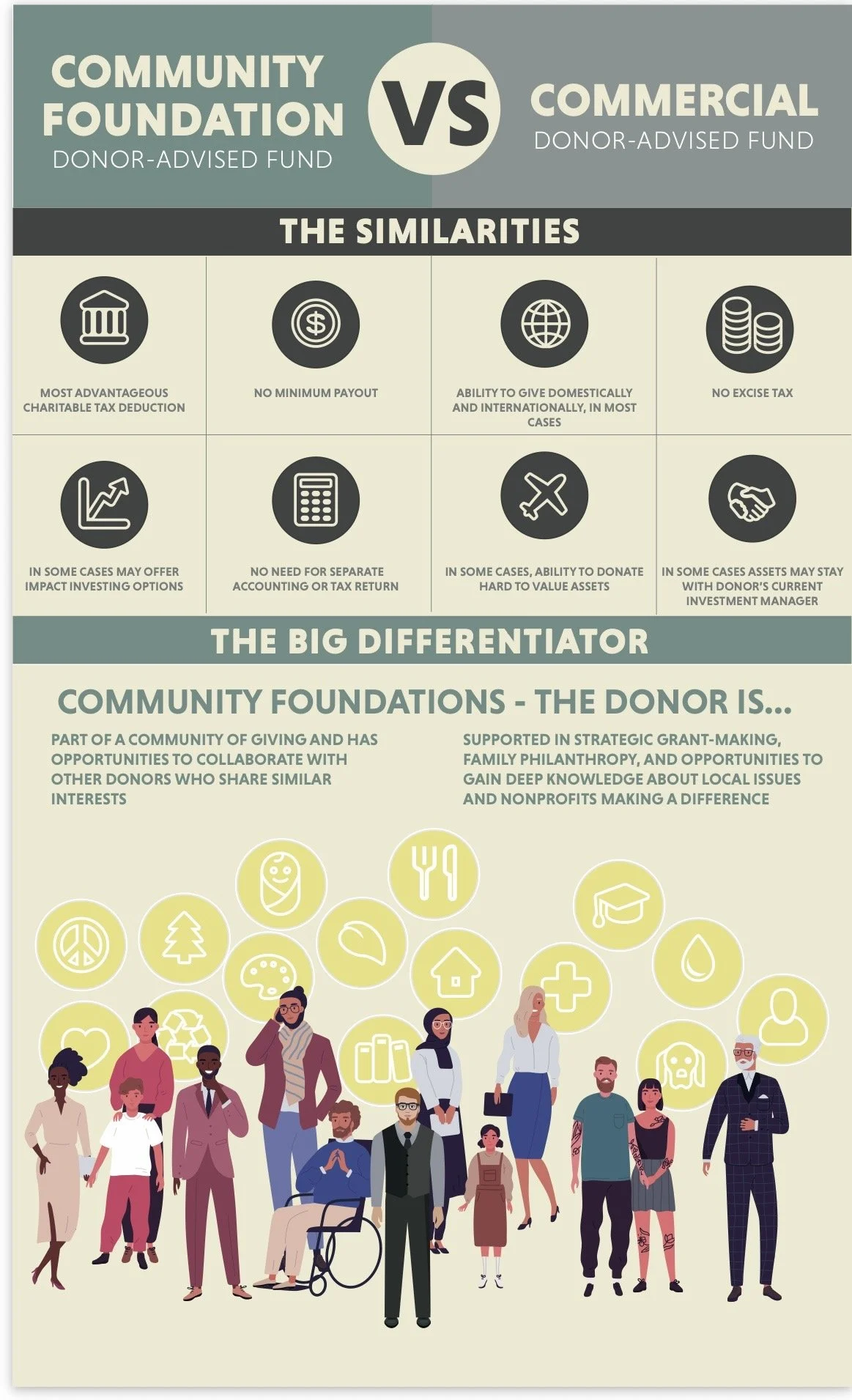
Community foundations operate with a unique structure, bringing together funds established by individuals, businesses, and families all under one roof. It’s easy to organize your charitable giving through donor-advised funds, field of interest funds, and scholarship funds to support the causes you love. 

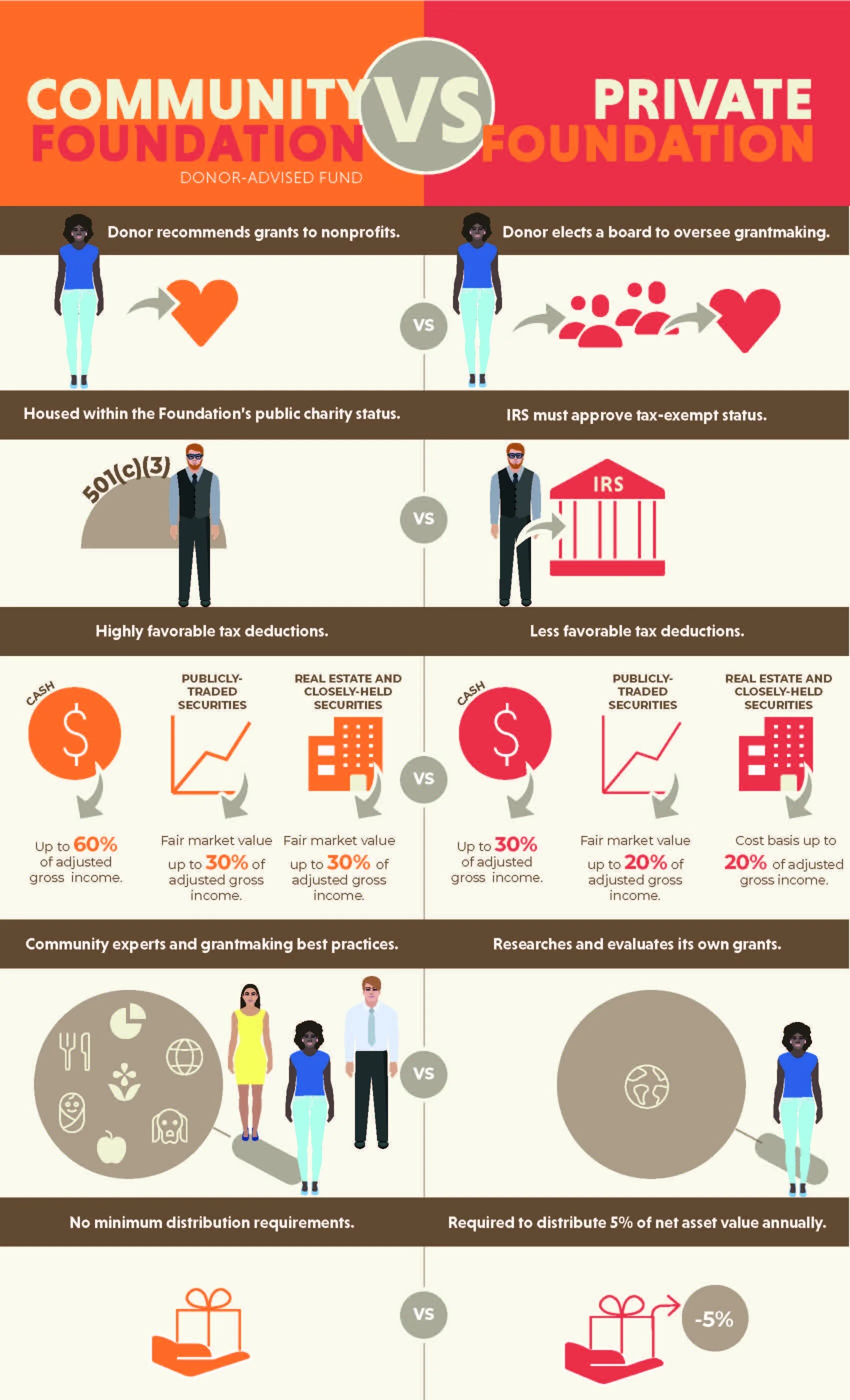
You may already know that a community foundation is a public charity recognized by the IRS, which means contributions are eligible for the most favorable charitable deductions under the tax law. What you might not know is that your community foundation is also dedicated to growing philanthropy to meet the most critical needs of the people in our region, today and tomorrow.

Every day, the team at the community foundation works with members of our board of directors, civic leaders, and nonprofit organizations to deeply understand the areas where the people in our community need the most help. Today, the most pressing needs might be for emergency assistance in response to a disaster. Tomorrow, our community might need scholarships for inner city youth, or investments in research to improve access to healthcare for the underserved. Indeed, the needs of our community are ever-changing. Your community foundation always has its finger on the pulse of the community’s top priorities and the best way to address them. Through its convening power, community knowledge, and perpetual mission, your community foundation is an unparalleled resource to make our community better for everyone.  

Many options for giving

We appreciate your support! We are grateful to so many donors who give cash or stock every year to funds they’ve established, or to the community foundation itself.

As we look ahead to growing our mission and serving even more people in our community, we are inviting dedicated donors like you to consider including the community foundation in your long-term charitable giving plans. Whether through a complex gift in the next year or so, or through a legacy gift in your estate plan, you can support your fund at the community foundation—or our mission in general—through a “planned gift.” In particular, when you support the community foundation’s mission, your gift will help sustain our operations and important programs that address critical community needs for many years to come.

A “planned gift” can take many forms, including:

  • A gift of real estate or private stock

  • A gift in your will or trust

  • A charitable remainder trust

  • A beneficiary designation of your life insurance policy, IRA, or other retirement plan

We welcome the opportunity to work with you and your advisors to structure a planned gift that makes a real difference for people in our region.

Dive into the details

Here are a few examples of specific types of planned gifts.

Leaving a bequest

If you’ve put together an estate plan with the help of an attorney, chances are, you’re familiar with the term “bequest.” A bequest is an instruction for assets or money to transfer to a person or charity following your death.

Here are ways you can leave a bequest to the community foundation.

Will or trust

You can include a bequest to the community foundation in your will or in a revocable living trust (a vehicle you establish to avoid probate). You can leave a specific dollar amount, or a portion of the “remainder” of your estate or trust after distributions to family and other beneficiaries. You can update your will or trust anytime prior to your death.

Beneficiary designation

You can leave a bequest through a beneficiary designation on your IRA or other retirement plan, or even on a life insurance policy. Beneficiary designations can be updated throughout your lifetime as your family and financial situation change. This is one of the most impactful and tax-efficient ways to leave a legacy.

Qualified charitable distributions

If you are aged 70 ½ or older, it is well worth your time to investigate whether a tool known as a Qualified Charitable Distribution might be right for you as a tax-savvy way to support certain types of funds at the community foundation or the community foundation itself. Here is how it works:

  • You can make a QCD if you have reached the age of 70½, and as such, you can direct up to $111,000 (2026 limit) annually from your traditional IRA to the community foundation.

  • If you’ve reached the age-73 threshold for IRS-mandated Required Minimum Distributions (RMDs) from qualified retirement plans, a QCD counts toward your RMD.

  • QCD transfers are not included in your taxable income.

  • The $111,000 cap (2026 limit) will be indexed for inflation.

Charitable remainder trust

A “charitable remainder trust” (sometimes referred to as a CRT) is a planned giving technique that allows you to make a future gift to the community foundation and be eligible for an up-front income tax deduction, and retain an income stream for life or for a period of years.

To establish a charitable remainder trust, you will work with your attorney to establish a trust agreement and also work with a person or entity who will serve as the trustee of the charitable remainder trust.

Your tax advisor will help you determine whether you could benefit from establishing a charitable remainder trust. Factors include:

  • Your plans to leave gifts to charity following your death to meet your charitable goals

  • Your income requirements while you are living

  • The types of assets you own and whether there is a particular highly-appreciated asset or assets (such as stock or real estate) that would make an ideal gift to a charitable remainder trust to reduce the capital gains tax exposure

Here’s how it works:

  • Your charitable remainder trust can name yourself or someone else to receive a potential income stream for a term of years, no more than 20, or for the life of one or more non-charitable beneficiaries (such as you and your spouse).

  • Your charitable remainder trust will name the community foundation to receive the remainder of the donated assets following the term of years or death of the income beneficiary or beneficiaries.

  • Your charitable remainder trust will establish the terms of the income stream received by the income beneficiary or beneficiaries.

  • A “charitable remainder annuity trust” (CRAT) distributes a fixed annuity amount each year. You cannot make additional contributions to a CRAT.

  • A “charitable remainder unitrust” (CRUT), on the other hand, distributes a fixed percentage (at least 5%) based on the balance of the trust assets (revalued annually), and you can make additional contributions to the trust during your lifetime.

  • At the end of the income beneficiary’s lifetime, or at the end of the term for the income interest, the remaining trust assets are distributed to the community foundation.

Charitable gift annuity

A charitable gift annuity is a planned giving vehicle that is a good fit if you like the idea of an up-front tax deduction, a steady lifetime income stream, and a remainder gift to charity. A charitable gift annuity (also referred to as a “CGA”) is similar to a charitable remainder trust, but often easier to establish, especially if you plan to set up a planned gift to the community foundation with $50,000 or less.

A CGA, like any other annuity, is a contract. You agree to make an irrevocable transfer of cash or assets to the community foundation. In return, our organization agrees to pay you (or a designated beneficiary such as a spouse) a fixed payment for life. You are eligible for an immediate income tax deduction for the present value of the future amount passing to charity.

How much income can you receive from a charitable gift annuity? That amount is determined according to national standards and is based on “rate of return” assumptions that are revised from time to time in response to changes in interest rates. Talk with our team to learn more about payout rates and what you might expect if you establish a charitable gift annuity to support the community foundation.

If you are over 70 ½, a charitable gift annuity might be particularly attractive. This is because a “Legacy IRA” rule allows for a once-in-a-lifetime, $55,000 (2026 limit) distribution from an IRA to a charitable gift annuity or charitable remainder trust. Your tax advisor can help you understand the taxability of your income payments from a charitable gift annuity, whether you establish the charitable gift annuity through a QCD, stock, or other assets.

Gifts of closely held stock

While not a legacy gift, giving closely held stock to the community foundation requires careful planning, so it is definitely a “planned gift”! It’s well worth exploring because these gifts of “complex assets” frequently result in strong tax benefits to you, as well as providing strong support to the community foundation and other organizations you care about.

In general, making a gift of highly-appreciated assets is a strong planning technique. When you contribute highly-appreciated stock in a public company, for example, to the community foundation, you are typically eligible for an income tax deduction at the stock’s fair market value on the date of the gift. When the community foundation sells the stock, our organization pays no capital gains tax. By contrast, you would have paid capital gains tax on the sale of the stock if you had sold it first and then transferred the proceeds to charity. The same is true for gifts of highly appreciated real estate and closely held stock; frequently, these assets have large unrealized capital gains.

If you are considering giving part (or all) of a closely-held business to charitable causes, please reach out. These transactions carry layers of complexity, largely concerning the timing of charitable gifts relative to the sale transaction. The best outcomes are achieved through a thoughtful, multi-step process. The team at the community foundation is happy to work with you and your tax and legal advisors to develop a plan to donate your business to charity. Many successful closely held exit transactions occur only after several years of planning—and most of that planning takes place well before potential buyers are even engaged. With the help of your tax and legal advisors, we can work with you and your advisors to ensure that your charitable intentions–as well as your tax intentions–are met through your gifts of closely held stock.

Gifts of real estate

If you own highly-appreciated residential, commercial, or undeveloped real estate, you may have reached the point where you no longer want to manage or maintain it. This is a perfect opportunity to discuss the option of giving real estate to the community foundation.

As with gifts of other long-term appreciated assets, your gift of real estate may be treated as a “current” gift, meaning you are transferring it in the near term. But it is still a gift that requires a lot of planning, and therefore belongs in the list of “planned gifts.”

Your gift of highly-appreciated real estate can help you avoid capital gains taxes and generate more money for the community foundation and other favorite charitable causes than you would have by selling the property first and donating the proceeds.

At the community foundation, we understand that, unlike cash or even stock, real estate is often tied to strong emotions that might surprise you when you start discussing disposition. We can help you structure a gift of real estate so that you can extend the emotionally important, family-related dynamics that may have been linked to the property for generations, even after our organization sells the property and invests the proceeds or deploys the proceeds to fund our programs and mission.

Life insurance

You may want to consider giving a life insurance policy to the community foundation. Giving a life insurance policy to a charitable organization, such as the community foundation, including through a beneficiary designation, is useful because the proceeds of that policy will not be included in your taxable estate for Federal estate tax purposes if that is a concern in your situation.

"Giving Now and Later" Article

Here’s an article to use on your website and in other materials to signal the importance of giving both during lifetime and through an estate plan. This material is useful where you want to inspire a legacy donor to also give annually.

Giving now and later: Expanding impact beyond your legacy gift

We are grateful that you are considering leaving an estate gift to the Community Foundation. Whether you name the Community Foundation in your will or trust or as the beneficiary of your IRA, your gift will help improve the quality of life for people in our region for years to come. 

At the Community Foundation, we’re honored to work with donors like you who are interested in ways to not only leave a legacy but also maximize their giving during their lifetimes. Indeed, many donors are interested in establishing a donor-advised or other type of fund at the Community Foundation for a variety of reasons:

  • They want to experience the joy of seeing the results of their gifts. 

  • Parallel to providing financial support through their Community Foundation fund, many donors enjoy the opportunity to get involved, whether as a volunteer, board member, or simply an observer at site visits to nonprofits they support. 

  • They want to involve their children and grandchildren in supporting favorite nonprofits, especially by working with the Community Foundation through a family donor-advised fund.

  • They like the added perk that they may be eligible for an income tax deduction for lifetime charitable gifts–and that the gifted assets are no longer subject to potential future estate taxes. 

The Community Foundation team would be honored to help you develop a lifetime and legacy giving plan, starting with the basics. As you consider whether the time might be right for you to formalize your giving plan, here are three tips to consider–all of which the Community Foundation can help you achieve:

  • Give to what you know. Most people experience the greatest joy from giving to causes they are personally familiar with. Personal experience makes it easier to understand how the nonprofit is using your dollars. So, for example, if you’ve had experience with helping foster children, you are likely to understand how the nonprofit is using your donation to support training for foster parents. Please ask the Community Foundation team for insights! It’s our job to keep up with the good work of nonprofits that are meeting local needs. 

  • Give where you are. Even with the increasing number of community challenges across the country and the globe, sometimes the greatest needs are right here at home. The Community Foundation team can help you identify opportunities to support local nonprofits by gathering information about a specific need and how a particular nonprofit addresses that need. When you give to local organizations, you are in a strong position to have confidence in your gift.

  • Give to the charities you love. Gifts aligned with your passions carry the most energy and ultimately make the most difference. The Community Foundation team is here to help bring your community dreams to life through the power of philanthropy. And that feels great! 

Please reach out to our team. We would be honored to work with you to create a lifetime and legacy giving plan. Thank you for being part of your Community Foundation.

"Your Home for Charitable Giving" Article

Use the copy below in articles, one-pagers, on your website, and in talking points to reinforce that the community foundation is a holistic organization with something for everyone.

Your Community Foundation: Honored to serve at the center of your philanthropy

Perhaps you established a fund at the Community Foundation years ago, or maybe you make donations to one or more Community Foundation funds as part of your annual charitable giving plan. Or perhaps you are considering establishing a donor-advised fund to help you keep your giving more organized and involve your children and grandchildren in your philanthropic priorities. Perhaps you’ve even named your Community Foundation fund in your will or trust to continue your legacy of giving beyond your lifetime. 

Whatever your situation may be, it’s a great idea to consider a few best practices for ensuring that you are tapping the Community Foundation’s full ability to help you make the biggest difference possible for the causes you care about. We invite you to lean on the Community Foundation’s wide range of charitable giving tools to help you achieve all of your philanthropic goals.

Here are a few benefits of tapping the Community Foundation to serve as the “hub” of your charitable giving:

  • The Community Foundation adopts a holistic approach to charitable giving so that you’re able to make a meaningful difference in the community we love. The Community Foundation’s mission, and the tools and services the Community Foundation provides, help you establish strong roots for your philanthropy from which so much good can grow. 

  • A donor-advised fund at the Community Foundation provides the convenience of a one-stop shop. You are able to make tax-deductible contributions of cash (or, ideally, appreciated stock) into the fund. You can recommend grants to your favorite charities–whether in our region or across the country. Make sure you’re leveraging your donor-advised fund to execute the full range of your charitable giving each year, including gifts to your alma mater, place of worship, and favorite local and national charities. You’ll find it so much easier to keep track over time of where you’re giving, and how much. 

  • Our team can help you establish a designated or field-of-interest fund to complement your donor-advised fund or other regular giving practices. A designated fund allows you to deepen your philanthropic roots in support of a specific charity over the long term, while a field-of-interest fund focuses your support on a particular area of community need by leveraging the Community Foundation’s expertise. 

  • If you are over the age of 70½, your designated fund or field-of-interest fund can receive “Qualified Charitable Distributions” from your IRA up to $111,000 per year (2026 limit) per spouse, bypassing your taxable income and, if applicable, counting toward your Required Minimum Distributions.

  • We can work with you and your attorney to help you name your Community Foundation fund in your will or trust to support the full range of your favorite nonprofits beyond your lifetime. Indeed, many Community Foundation donors name their donor-advised funds, field-of-interest funds, designated funds, or even the Community Foundation itself, as beneficiaries in their wills and trusts, and especially as beneficiaries of IRAs and other qualified retirement plans, because doing so delivers significant tax benefits and complements the estate planning process. 

  • The Community Foundation is happy to work with you and your estate planning attorney to document and execute your charitable intentions for distributions following your death. So, for example, instead of listing each individual nonprofit in your will or trust, name your Community Foundation Fund to receive the entire charitable portion of your estate, which the Community Foundation will distribute according to your wishes to your favorite charities, as well as honoring your wishes that a portion stay with the Community Foundation to support the Community Foundation’s mission in perpetuity.  

  • The Community Foundation offers opportunities for donors to get together and learn from each other as a group. If you’re not involved already, please reach out, and we’ll fill you in! We can help you and your family learn more about your favorite nonprofit organizations and the issues they are addressing so that you can become more informed and effective philanthropists in our community and beyond. The Community Foundation team’s unparalleled, deep knowledge of local issues and organizations is a real advantage for you and your family. When you better understand the needs of the community and how your favorite nonprofits are addressing those needs, you’ll be better equipped to structure your giving so that it makes a difference in measurable ways. You’ll enjoy your charitable giving a lot more, too, when it’s rooted in the best practices the Community Foundation offers.

The Community Foundation is here to help you make the most of your philanthropy across the board so that you’re not only putting your money to work to improve the quality of life in our community and beyond, but you’re also achieving financial and philanthropic goals for your overall charitable giving.  

Thank you for the opportunity to work together! 

Planned Giving One-Pager or Email

Use the copy below to create your own very simple planned giving email or one-pager to help your donors and fund holders learn how they can add to their funds, or even plant the seed for support the community foundation’s mission.

The Community Foundation has been serving the people of our community for [ ] years. The needs in our community—and specifically the needs the Community Foundation addresses on a daily basis—continue to grow. As stewards of our mission, our staff and board of directors are committed to ensuring that our organization can continue to serve our community right now and for years to come.

We appreciate your support! We are grateful to so many donors who give cash or stock every year or have supported our capital and growth campaigns.

As we look ahead to growing our mission and serving even more people in our community, we are inviting dedicated donors like you to consider including the Community Foundation in your long-term charitable giving plans. Whether through a complex gift in the next year or so, or through a legacy gift in your estate plan, you can support the Community Foundation through a “planned gift,” knowing that your gift to the Community Foundation will help fund our operations and important programs.

A planned gift can take many forms, including:

  • A gift of real estate or private stock

  • A gift in your will or trust

  • A charitable remainder trust

  • A beneficiary designation of your life insurance policy, IRA, or other retirement plan

We welcome the opportunity to work with you to support the Community Foundation for years to come. We are so grateful for your loyalty to our mission.

Fact Sheets

Use our fact sheet templates to build your own!

Even more samples

At Embolden, we’re happy to share samples of materials that have worked well for us personally over the years. Visit our “Even more samples” page to get inspired!